
AI Expert Alejandro Saucedo, who serves at the UN, European Commission, and Zalando, published the second installment of his series on how artificial intelligence agents remember. Titled Whose Memory Is It? Building Multi-Tenant, Multi-Tier Memory for AI Agents (Part 2), the release details advanced design choices for handling multi-tenant memory persistence within the Kubernetes Agent Orchestration System (KAOS).
Establishing a Simplified Three-Tier Memory Model
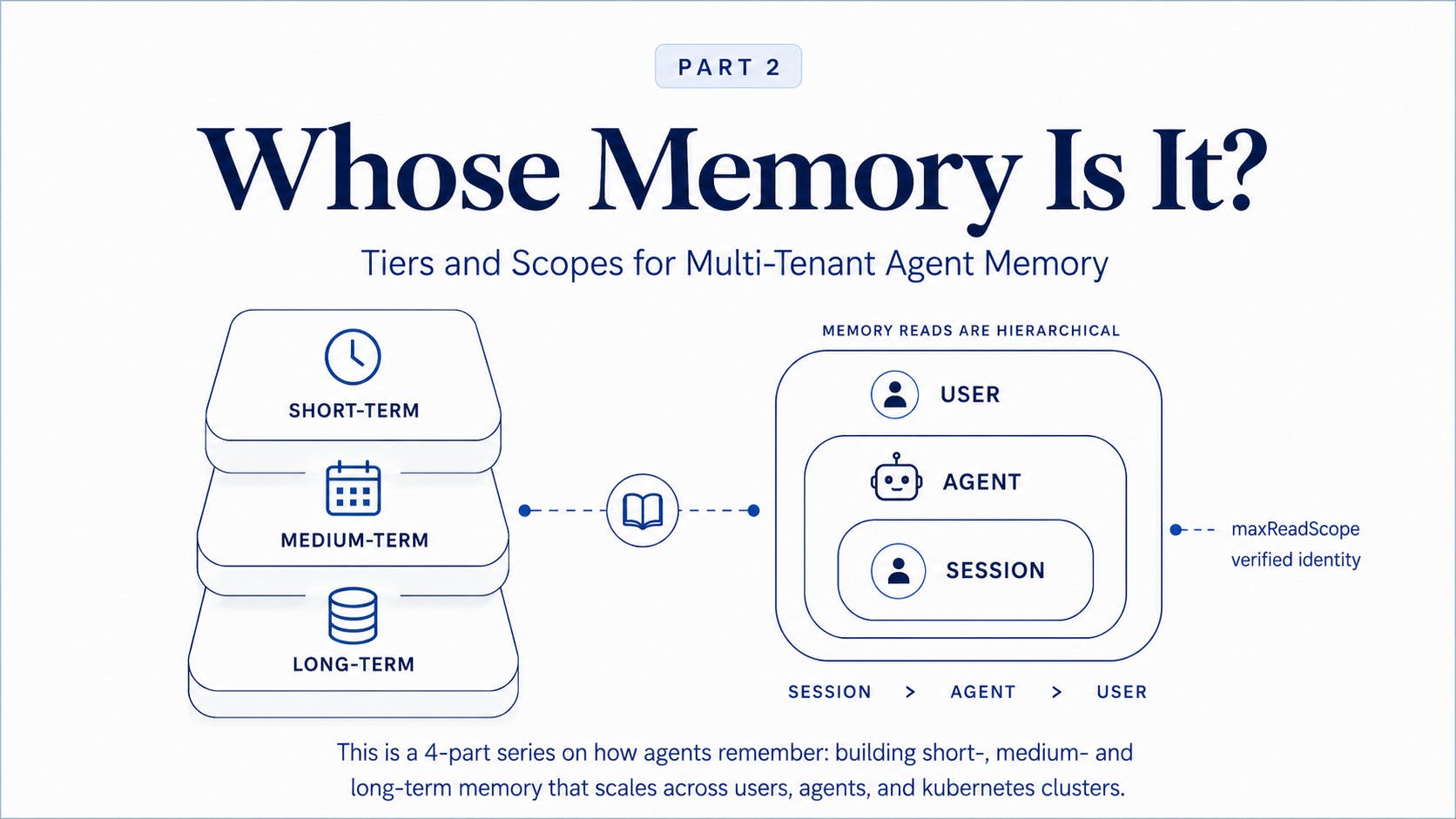
Following the first part of the series—which surveyed approximately 30 memory engines and adopted Mem0 as a library—Saucedo established a simplified three-tier memory architecture. This framework consists of a short-term window, a medium-term summary, and long-term facts. The short-term tier handles the live session context window bounded by a token budget and updates every turn using relational rows. The medium-term tier maintains a rolling summary per session, while the long-term tier extracts atomic facts keyed by scope and recalls them semantically using vector stores.
Defining Access Scopes and Write Provenance
Every memory operation in a multi-tenant system requires strict boundaries regarding ownership and data privacy. KAOS records compound and invariant metadata provenance for every memory input stored, capturing the user_id, agent identity, and session identifier. For read operations, a hierarchical relationship restricts access based on security posture and verified request headers. Identity verification prevents unauthorized access, ensuring that cross-agent user reads exist only when the store owner deliberately raises the ceiling.
Key Architectural Lessons for Production Systems
The architectural framework provides critical takeaways for deploying scalable agentic memory layers. Systems must treat verbatim windows and cross-session distilled facts as separate memory tiers with distinct lifecycles. Furthermore, maintaining durable verbatim records ensures survival against lost extractions, while server-side scope derivation from authenticated identity prevents memory poisoning and cross-session injection attacks.