
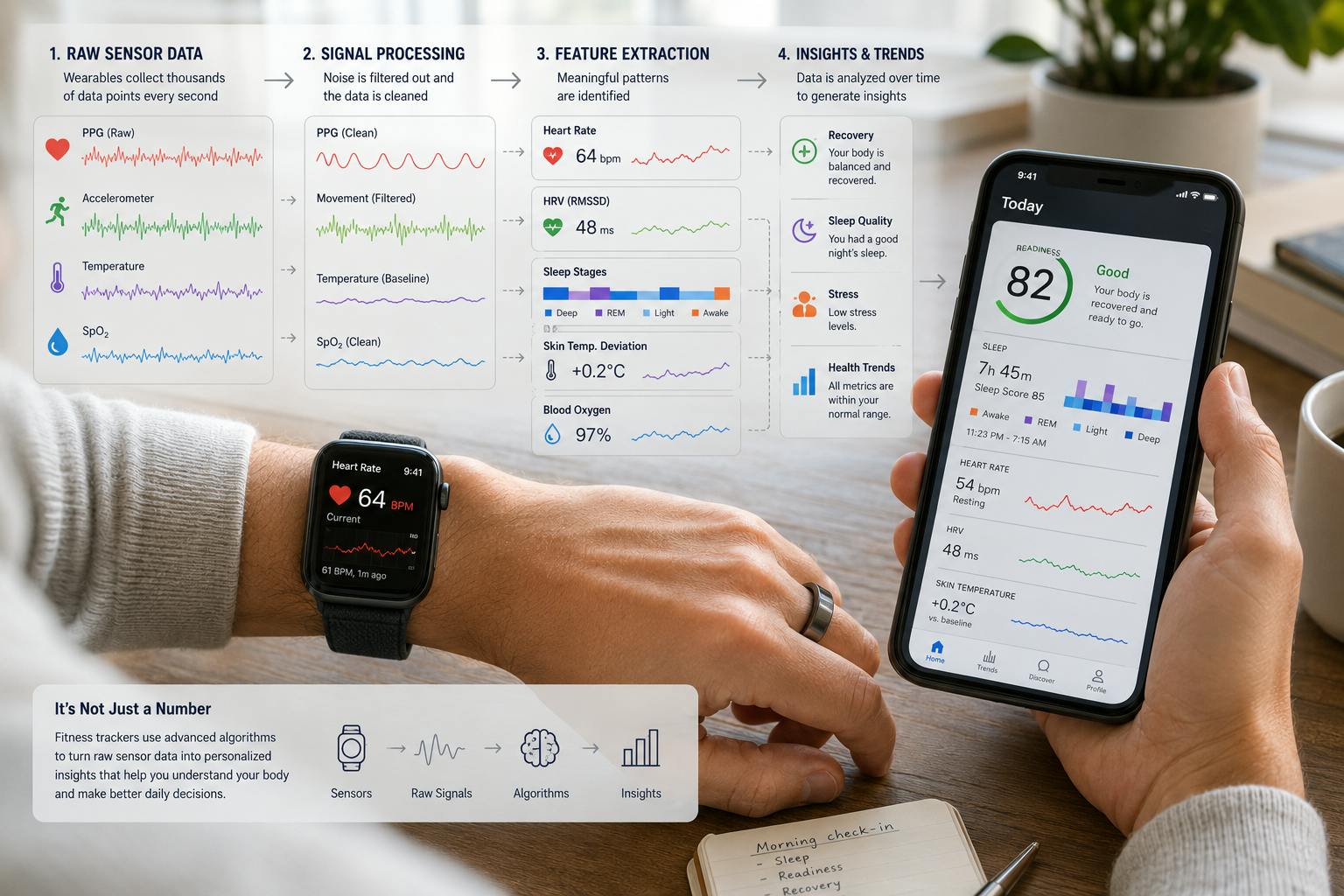

Modern smart wearables, ranging from devices like the Apple Watch to the Oura Ring, constantly collect raw sensor metrics such as heart rate, movement, and temperature, transforming them into comprehensive sleep and recovery scores. Wearable tech writer Shradha Puri, publishing via HackerNoon on August 10th, 2026, emphasizes that these devices rely on complex mathematical algorithms behind the scenes rather than direct measurements of human fatigue or stress.
The Hardware and Signal Processing Layer
At the core of fitness tracking hardware are specialized sensors including photoplethysmography (PPG) for heart rate, accelerometers, gyroscopes, temperature sensors, and SpO2 sensors. A PPG sensor shines light through the skin to track blood flow fluctuations in capillaries. However, raw data from these sensors is inherently messy, affected by movement, lighting, and skin tone. To achieve reliability, algorithms utilize adaptive noise cancellation—often pairing accelerometer data as a reference signal with notch filtering—to strip out motion artifacts and reduce errors to under 1 beat per minute.
Translating Metrics into Recovery and Sleep Scores
Beyond basic heart rate monitoring, devices analyze heart rate variability (HRV), specifically the RMSSD metric, to evaluate parasympathetic nervous system activity. A 14-day observational study using chest-strap sensors associated higher morning RMSSD with improved sleep and lower stress. Similarly, sleep tracking platforms utilize multi-signal inputs including movement, heart rate, and temperature to estimate sleep stages. While traditional polysomnography remains the medical standard, a 2023 validation study demonstrated that neural networks trained on motion and heart rate metrics achieved 77.8% accuracy in predicting 4-stage sleep models.
Personalization, Limitations, and Proprietary Analytics
Because physiological responses vary significantly between individuals, modern trackers establish personal baselines by comparing nightly data against 14-day or 3-month averages. However, technological limitations persist. A 2024 systematic review and meta-analysis encompassing 197,353 pairs of measurements revealed that SpO2 and pulse rate readings can breach FDA industry standards, showing pronounced bias in patients with darker skin pigmentation. Furthermore, manufacturers interpret identical physiological metrics differently; a 2025 academic review analyzing 10 leading health device brands highlighted that while 86% of composite scores incorporate HRV, platforms like WHOOP isolate deep-sleep HRV, whereas Garmin deploys the Firstbeat analytics engine to calculate dynamic energy reserves.