

Researchers at the University of Chicago Pritzker School of Molecular Engineering (UChicago PME) have uncovered a groundbreaking quantum phenomenon in the two-dimensional magnetic material Fe5GeTe2. Published on August 7, 2026, in Science Advances, the study reveals that millions of electrons inside this unique van der Waals magnet slow down to a near crawl while moving together in quantum lockstep, challenging current theoretical models and pointing toward revolutionary computer memory applications.
A Surprising Quantum Many-Body Phenomenon
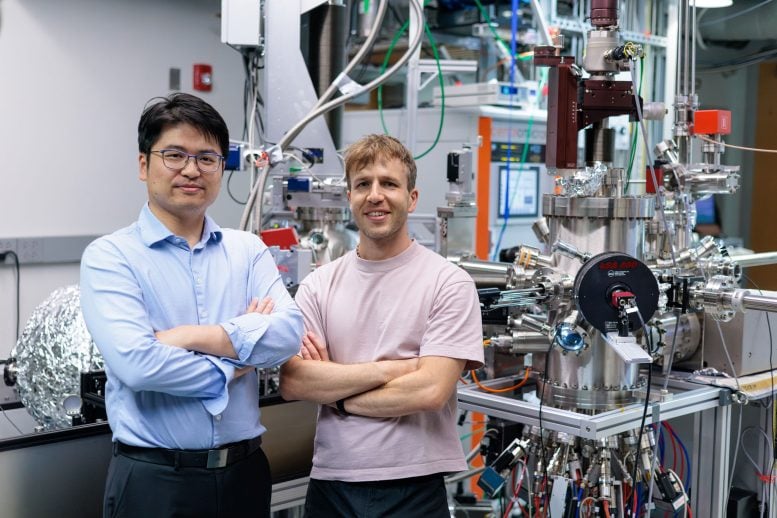
Led by Assistant Professor Shuolong Yang, alongside postdoctoral scholars Gabriele Berruto and Qiang Gao, the research team investigated the material using angle-resolved photoemission spectroscopy (ARPES). By focusing an ultraviolet laser down to a 10-micrometer spot, the scientists discovered a remarkably flat electronic band. Unlike normal electronic bands that act like steep slopes allowing electrons to rush through, this flat band forces electrons to move collectively at drastically reduced speeds, exhibiting a rare quantum many-body state.
Challenging Established Magnetic Theories
The discovery forces physicists to rethink the fundamental magnetic interactions within Fe5GeTe2. Because the material belongs to the van der Waals family—composed of strongly bonded atomic sheets held by weak interlayer forces—it can be scaled down to thin layers while retaining robust magnetism. Earlier studies showed ferromagnetism surviving up to 293 kelvins in 12-nanometer films. The newly observed coherent slow response persisted up to about 100 kelvins, offering a surprisingly robust platform for delicate quantum states.
Paving the Way for Light-Controlled Memory Devices
The implications extend far beyond basic physics, opening new pathways for advanced electronics and spintronics. By using a microfocused laser to switch the material between different electronic and magnetic phases, the researchers demonstrated the potential to control information using light rather than traditional electrical methods. Although scaling the effect to room temperature remains a primary hurdle, the team plans to exfoliate Fe5GeTe2 down to a single atomic layer, bringing future ultrathin memory devices closer to reality. The study also stands as a tribute to distinguished UChicago physicist Peter Littlewood, who passed away on June 15.