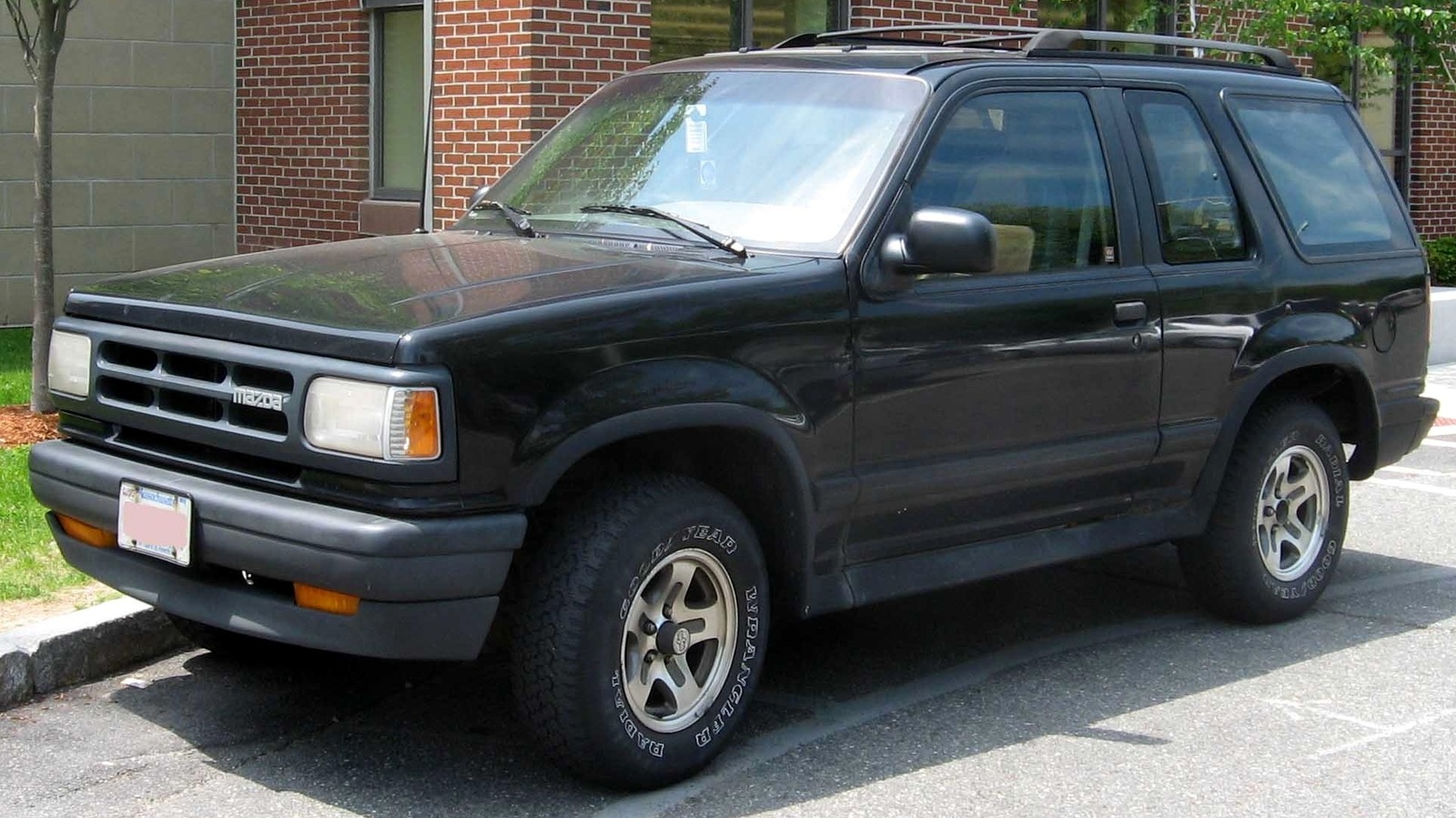

Back in 1991, Japanese automaker Mazda entered the SUV market through a strategic supply partnership with Ford, which held a 25% stake in the company at the time. Rather than developing an entirely new platform, Mazda introduced the Mazda Navajo—which was fundamentally a first-generation two-door Ford Explorer Sport assembled at the Ford plant in Louisville, Kentucky. Designated exclusively for the U.S. market, the vehicle served as Mazda‘s first-ever SUV offering before production ended in 1994.
Design Tweaks And Industry Recognition
To differentiate the vehicle from its Ford counterpart, Mazda applied distinct exterior modifications. The Navajo featured a unique front fascia, new headlights, taillights, and custom wheels. Despite the badge engineering, the vehicle earned critical acclaim, capturing Motor Trend‘s prestigious Truck of the Year award in 1991. The model launched with a single trim level in 1991, followed by the introduction of DX and LX trims for the 1992 model year.
Performance And Powertrain Specifications
Every Mazda Navajo produced between 1991 and 1994 relied on a Ford 4.0-liter Cologne V6 engine. The initial 1991 powertrain generated 155 horsepower and 220 lb-ft of torque, paired with either a standard five-speed manual transmission or a four-speed automatic. Power output saw a slight increase to 160 hp for the 1993 model year. Equipped with the manual transmission, the SUV achieved a 0 to 60 mph acceleration time of approximately 10 seconds. The setup also included part-time four-wheel drive and a rear-wheel anti-lock brake system.
Market Legacy And Modern Value
Although production lasted for only a few short years, the Navajo remains an intriguing piece of automotive history. While modern offerings like the Mazda CX-90 generate between 280 and 340 horsepower, enthusiasts today can find classic Navajo models on the used market for under $4,000, with certain listings appearing around $3,795.