
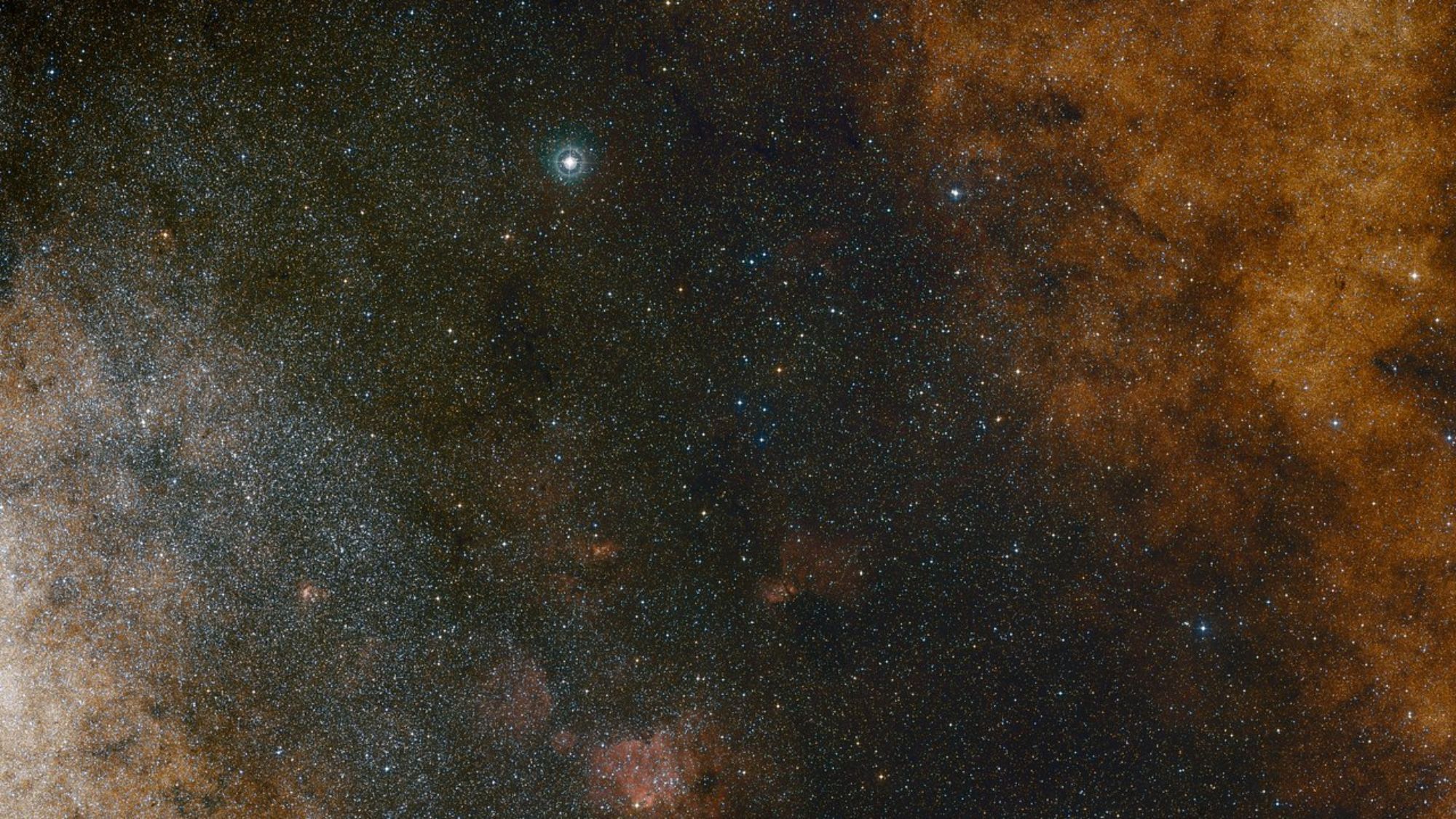

Astronomers have made a groundbreaking discovery in the heart of our galaxy, identifying the fastest known star in the Milky Way. Designated as S301, this faint celestial object is seen hurtling around Sagittarius A*, the supermassive black hole situated at the galactic center.
During its extreme journey, the star reaches staggering speeds of approximately 15,500 miles or 25,000 kilometers per second. This velocity equates to more than 8% of the speed of light, making it roughly 100,000 times faster than a commercial airplane.
An Unprecedented Cosmic Orbit
What sets S301 apart from other cosmic bodies is its remarkably tight and elongated orbit. The star completes a full revolution around Sagittarius A* in just 8.7 years, approaching the massive black hole at a distance comparable to that between Saturn and the Sun.
‘What is special about this star is that it’s orbiting Sagittarius A* on a very tight orbit, taking just 8.7 years to complete it, and is approaching the black hole at a mere 12 times the distance of Earth to the sun. That is unprecedented,’ stated Felix Mang, a Ph.D. student at the Max Planck Institute for Extraterrestrial Physics in Germany.
Testing Einstein’s Theory of Relativity
This phenomenal discovery provides scientists with a novel method to probe the roughly 4.3-million-solar-mass black hole. According to Einstein‘s theory of general relativity, a rotating black hole drags the fabric of spacetime along with it—a phenomenon known as frame dragging or Lense-Thirring precession.
Because S301 ventures so close to Sagittarius A*, these spacetime distortions are expected to alter its orbit gradually. Researchers believe these changes could become measurable within approximately a decade.
‘For the first time, we would actually be able to measure very directly the spin of a massive black hole, which would be a key test of Einstein‘s theory,’ explained study co-author Dr. Stefan Gillessen, a senior scientist at the Max Planck Institute.
Tracing the Origins of S301
Researchers initially spotted S301 in 2023 utilizing the GRAVITY instrument on the European Southern Observatory‘s Very Large Telescope Interferometer located in Chile. Scientists subsequently traced its trajectory back through archival data from 2021 and 2017.
The highly eccentric nature of its orbit implies that S301 may have once belonged to a binary star system that wandered too dangerously close to Sagittarius A*. The black hole may have captured S301 while violently flinging its stellar companion outward at immense speeds.
Astronomers intend to continue monitoring S301 using upgraded tools like GRAVITY+ and eventually the Extremely Large Telescope. With its next close pass anticipated in 2031, observations spanning two complete orbits could finally unveil the rotation spin of Sagittarius A*.