
A team of astrophysicists and data scientists at NASA’s COFFIES (Consequence Of Fields and Flows in the Interior and Exterior of the Sun) has developed a revolutionary machine-learning model capable of predicting the emergence of active solar regions up to 12 hours before they appear on the Sun’s surface. As space exploration intensifies with upcoming missions to the Moon and Mars, this groundbreaking artificial intelligence tool aims to protect astronauts, satellites, and Earth’s radio communications from dangerous solar storms.
The Science Behind Solar Storm Predictions
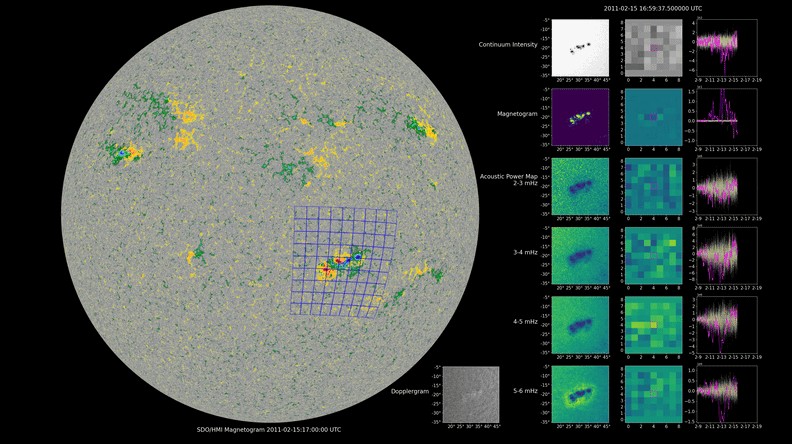
The Sun is in a constant state of turmoil, where intense concentrations of localized magnetic fields break through the surface to create sunspots. These sunspots act as the visible engines behind severe space weather events, including solar flares and coronal mass ejections. To capture these elusive precursors, researchers from the New Jersey Institute of Technology (NJIT), Princeton University, and NASA’s Ames Research Center utilized advanced AI architectures. Analyzing data from the Solar Dynamics Observatory and leveraging supercomputing resources, the team tracked subtle fluctuations in acoustic waves generated deep beneath the solar interior before sunspots emerge.
Revolutionizing Space Weather Forecasting
Traditional forecasting methods typically rely on monitoring sunspots that are already visible on the solar surface. However, the new AI approach uses a specialized sliding-window transformer architecture to detect tiny reductions in acoustic activity and magnetic fields that signal upcoming active regions. Published in the Journal of Geophysical Research: Machine Learning and Computation, this methodology allows forecasters to pinpoint approximate locations of future sunspots well in advance, providing crucial preparation time for teams such as NASA’s Space Radiation Analysis Group and the Moon to Mars Space Weather Analysis Office.
Safeguarding Future Deep-Space Explorers
While the machine-learning model is still undergoing validation across various historical solar events before entering real-time operational forecasting, its potential is immense. Experts like Michelangelo Romano, deputy director of the M2M SWAO, emphasize that this early-warning capability will offer vital strategic advantages. By bridging institutional expertise under the NASA DRIVE Science Center framework, this advancement marks a significant milestone in heliophysics, ensuring safer conditions for humanity’s future among the stars.