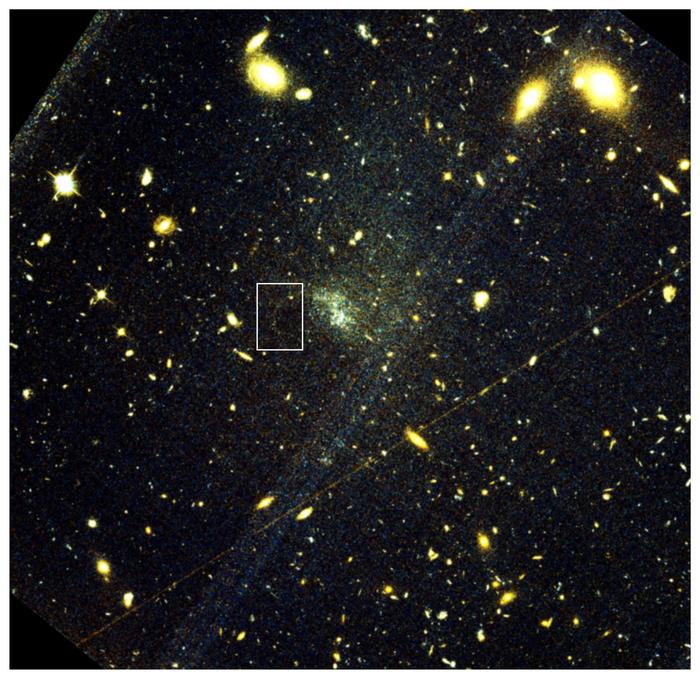

Astronomers have uncovered the first-ever globular cluster stellar stream located outside the Milky Way, transforming our ability to study elusive dark matter. Published on August 12, 2026, in the journal Nature, the groundbreaking study leverages archival data from the Hubble Space Telescope to reveal a faint ribbon of stars—dubbed Oyashio—streaming away from a cluster in the ultra-diffuse galaxy UGC 9050-Dw1, situated 115 million light-years from Earth.
Unprecedented Discovery in Archive Data
The monumental finding was spearheaded by an international research team co-led by Julie Kiel Holm of the University of Copenhagen and Sarah Pearson of the Technical University of Denmark, alongside co-authors including Tjitske Starkenburg of Northwestern University. The data was originally captured in September 2022 by David Sand and Catherine Fielder of the University of Arizona under NASA program ID 16890, and later scrutinized by co-author David Hendel. Located in an ultra-diffuse galaxy where stars are sparse, the stellar stream stood out against a dark background, making it visible despite the immense distance.
A New Tool to Measure Dark Matter
By analyzing the curved shape of the Oyashio stream, scientists were able to reconstruct the gravitational field of UGC 9050-Dw1. Because visible matter like stars accounts for only a fraction of the total mass, this gravitational modeling allowed researchers to accurately calculate the distribution of dark matter. Tjitske Starkenburg noted that modeling the nearly identical orbits of the stars within the stream provides a reliable estimate of the galaxy’s total mass, offering a brand new probe for extragalactic dark matter that aligns seamlessly with older methods.
The Future of Extragalactic Astronomy
The successful detection of the Oyashio stream proves that tidal stream methods work far beyond our galactic neighborhood. With next-generation observatories on the horizon—particularly the Nancy Grace Roman Telescope, which boasts a field of view 100 times larger than Hubble—astronomers anticipate uncovering many more extragalactic stellar streams, opening unprecedented windows into the structure and evolution of the universe.