
A collaborative team of researchers from the University of Exeter and Cardiff University published groundbreaking findings in the peer-reviewed journal Science on July 2, 2026, revealing that the world’s tallest tropical trees have evolved sophisticated mechanisms to overcome height-related physiological limitations, completely overturning a decades-old scientific theory regarding tree growth and drought vulnerability.
Overcoming Hydraulic Limitations at Extreme Heights
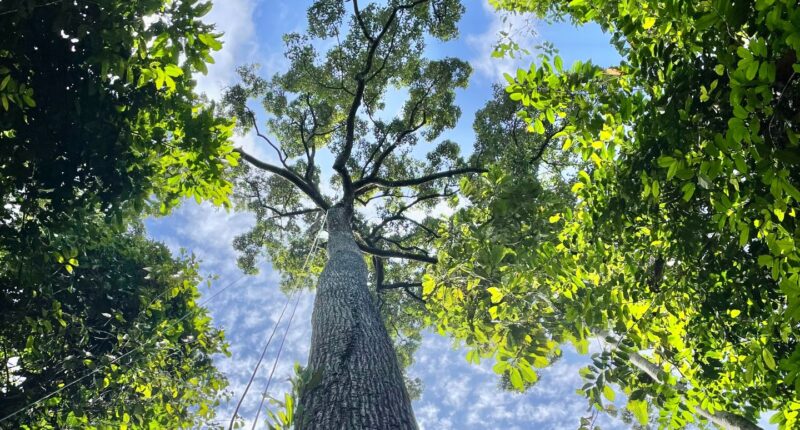
For decades, scientists believed that height inherently disadvantaged the world’s tallest trees. Researchers theorized that as water traveled farther from roots to leaves, the physical distance created an insurmountable bottleneck. Because trees lack a heart or mechanical pump, they rely entirely on microscopic vessels where evaporating moisture pulls water upward from the roots. Scientists previously assumed that reaching heights exceeding 230 feet (70 meters) would create extreme low pressure, severely limiting photosynthesis and rendering canopy giants dangerously vulnerable to drought conditions.
Inside the Malaysian Borneo Canopy Study
To investigate how Earth’s tallest flowering plants manage such extreme dimensions, researchers conducted rigorous fieldwork studying dipterocarp trees in the rainforests of Malaysian Borneo. The team measured vital water-transport traits across specimens ranging from 23 to 233 feet (7 to 71 meters) tall. Crucially, scientists tracked trunk growth rates before, during, and after the intense El Niño drought period of 2023–2024 to evaluate real-world resilience under severe water stress.
Adaptations That Keep Forest Giants Thriving
The study discovered that taller trees actively compensate for their massive scale through remarkable biological adaptations. Water-conducting vessels systematically become wider closer to the ground, facilitating smoother fluid transport through the trunk. Furthermore, canopy leaves have adapted to tolerate significantly higher levels of water stress before wilting. Professor Lucy Rowland from the University of Exeter noted that these intricate vascular adaptations maintain water in liquid form even under extreme low pressures. Consequently, data proved that taller trees experienced no height-related loss in growth during the El Niño drought compared to smaller specimens.
Global Climate Implications and Carbon Storage
These findings carry profound implications for global climate science and carbon cycling. According to Paulo Bittencourt from Cardiff University, the tallest 1% of trees store more than half of all above-ground carbon in forests, acting as vital long-term carbon reservoirs that lock away carbon for decades or centuries. Co-author Palasiah Jotan hopes these insights will strengthen ongoing conservation initiatives to protect Borneo’s rainforests, emphasizing that while giant trees are remarkably resilient to drought, safeguarding these majestic ecosystems remains critical for global biodiversity and climate stability.