
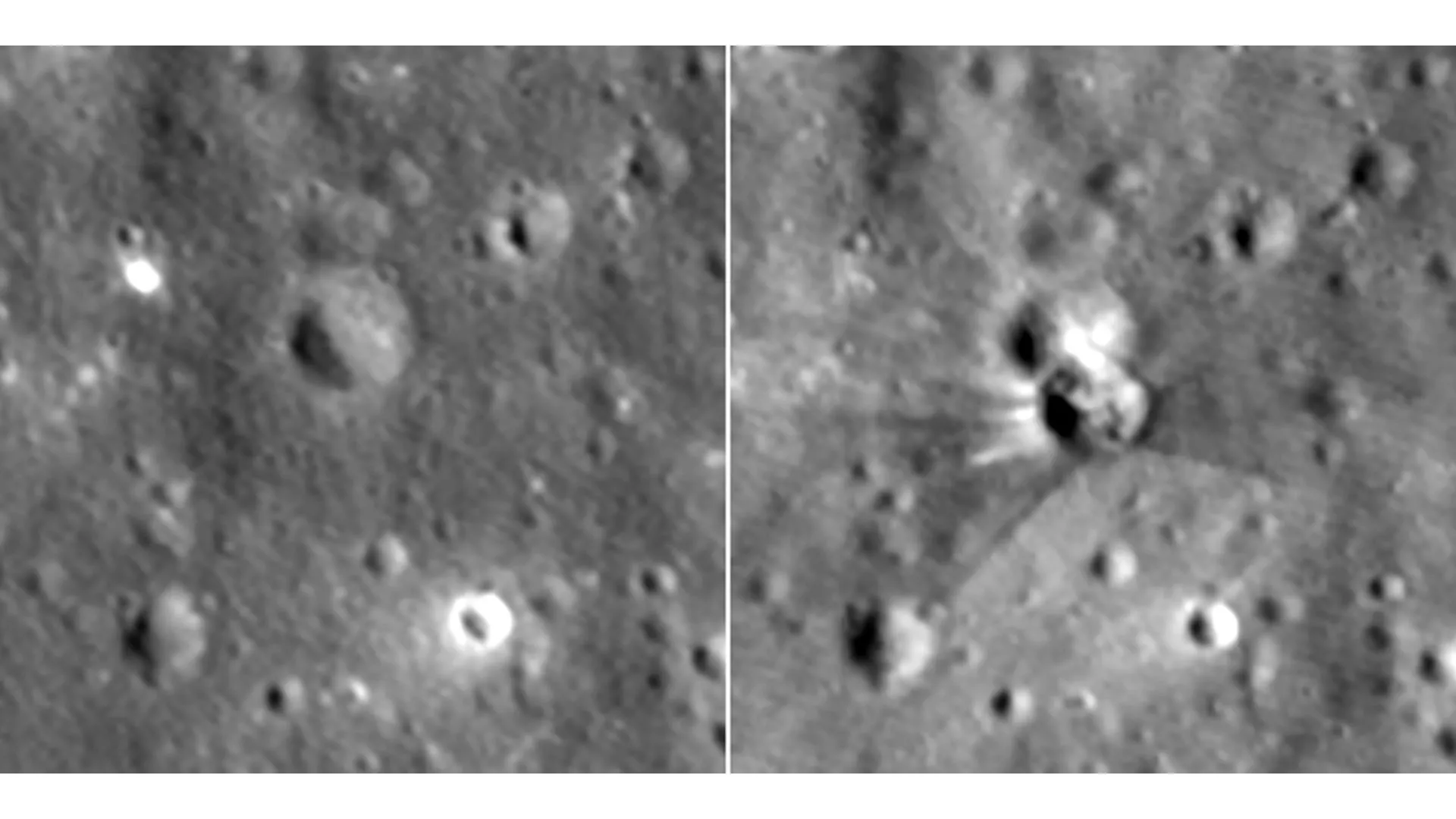

NASA has officially released the first striking images of a massive crater carved into the lunar surface by an out-of-control SpaceX Falcon 9 upper stage. The massive 9,920lbs (4,500kg) and 39ft-long rocket section careened into the Moon on August 5, 2026, traveling at an astonishing speed of 5,400 miles per hour (8,690 km/h). Scientists estimate the violent collision delivered a force equivalent to 15,000 sticks of dynamite.
Precision Engineering and Orbital Maneuvers
Capturing the impact site required extraordinarily careful orbital maneuvering by the Lunar Reconnaissance Orbiter (LRO). Engineers deliberately tilted the spacecraft so its high-resolution Narrow Angle Camera could point directly toward the crater as the satellite swept overhead at roughly 60 miles above the lunar surface. Traveling at 1 mile per second, the orbiter had to wait precisely for the target location to rotate into view, a process that took six days before optimal photographic conditions arose.
Timing was paramount for the success of the mission, as a photograph captured merely 10 seconds too early or late would have missed the target by about 10 miles. Analyzing the shadows and lighting angles, researchers determined the resulting crater spans approximately 60 feet (18 meters) in width while plunging less than 10 feet (3 meters) deep. The precise coordinates of the impact site were successfully pinned down to 19.4759°N, 266.7138°E at an elevation of 511 meters (1,676 feet).
Fresh Lunar Material and International Collaboration
The newly captured images reveal fascinating bright and dark rays stretching outward from the impact center. The darker streaks consist of ancient surface dust and rocks weathered over countless millennia by solar wind, galactic cosmic rays, and micrometeorite impacts, blasted upward from a depth of 1.5 feet. Meanwhile, the bright streaks near the rim expose fresh, pristine material excavated from deeper underground.
Locating the site demanded a remarkable international effort combining professional researchers and amateur astronomers. Independent astronomer Bill Gray first calculated the rocket’s trajectory, which was later refined by NASA‘s Center for Near Earth Object Studies at the Jet Propulsion Laboratory in Southern California. The Republic of Korea and its Korea Pathfinder Lunar Orbiter (Danuri) team also played a crucial role, using their onboard LUTI camera to photograph the region and verify calculations to within 0.6 miles.
‘Spotted: Falcon 9 impact site,’ NASA announced on X, detailing how the collaboration successfully expanded our understanding of lunar impacts.