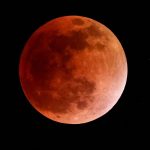
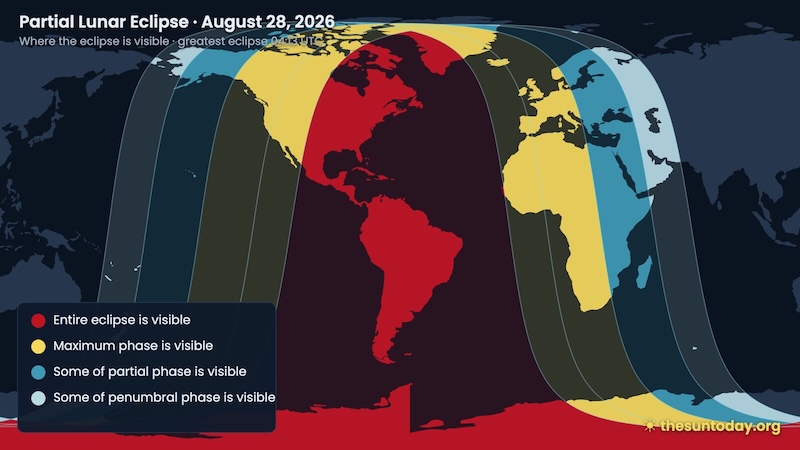

Skywatchers across the globe are preparing for a breathtaking celestial event as a deep partial lunar eclipse is set to take place on August 27-28, 2026. Covering approximately 96% of the Moon’s surface in Earth’s dark umbral shadow, this near-total spectacle will be prominently visible across the Americas, Africa, Europe, and parts of Antarctica and the eastern Pacific Ocean. Belonging to Saros 138, the astronomical phenomenon offers a striking visual contrast between a glowing red-orange copper disc and a brilliant silver crescent.
Timeline and Global Visibility of the 2026 Eclipse
The monumental celestial alignment will kick off with the penumbral phase at 1:23 UTC on August 28, translating to 8:23 p.m. CDT on August 27. As the shadow deepens, the partial eclipse officially begins at 2:33 UTC (9:33 p.m. CDT). The moment of greatest eclipse is scheduled for 4:12 UTC (11:12 p.m. CDT), during which roughly 96.1% of the lunar disk will lie completely submerged within the umbra. At this exact zenith, the Moon will sit directly overhead in the Brazilian Amazon. The entire event will span roughly 3 hours and 25 minutes, wrapping up as the penumbral eclipse ends at 7:02 UTC (2:02 a.m. CDT).
What to Expect: The Visuals of a 96% Eclipse
While falling just short of totality, a 96% coverage provides a visual experience strikingly similar to a total lunar eclipse, often dubbed the blood Moon effect. Observers can anticipate a deep orange-copper hue blanketing the shadowed portion of the lunar surface due to sunlight refracting through Earth’s atmosphere. Meanwhile, a dazzling bright silver patch of direct sunlight will remain along the northeastern limb. For those situated in the United States and across South America, conditions are exceptionally favorable, offering an uninterrupted view of the peak stages.
Safe Viewing and Equipment Recommendations
Unlike solar spectacles, lunar eclipses are completely safe to observe with the naked eye, requiring no specialized filters or protective solar glasses. According to astronomical guides provided by platforms like timeanddate.com and Sky Tonight, viewers can comfortably enjoy the event without equipment. However, optical aids such as binoculars and telescopes will significantly enhance the intricate details of the craters and the vivid color contrasts across the constellation of Aquarius.