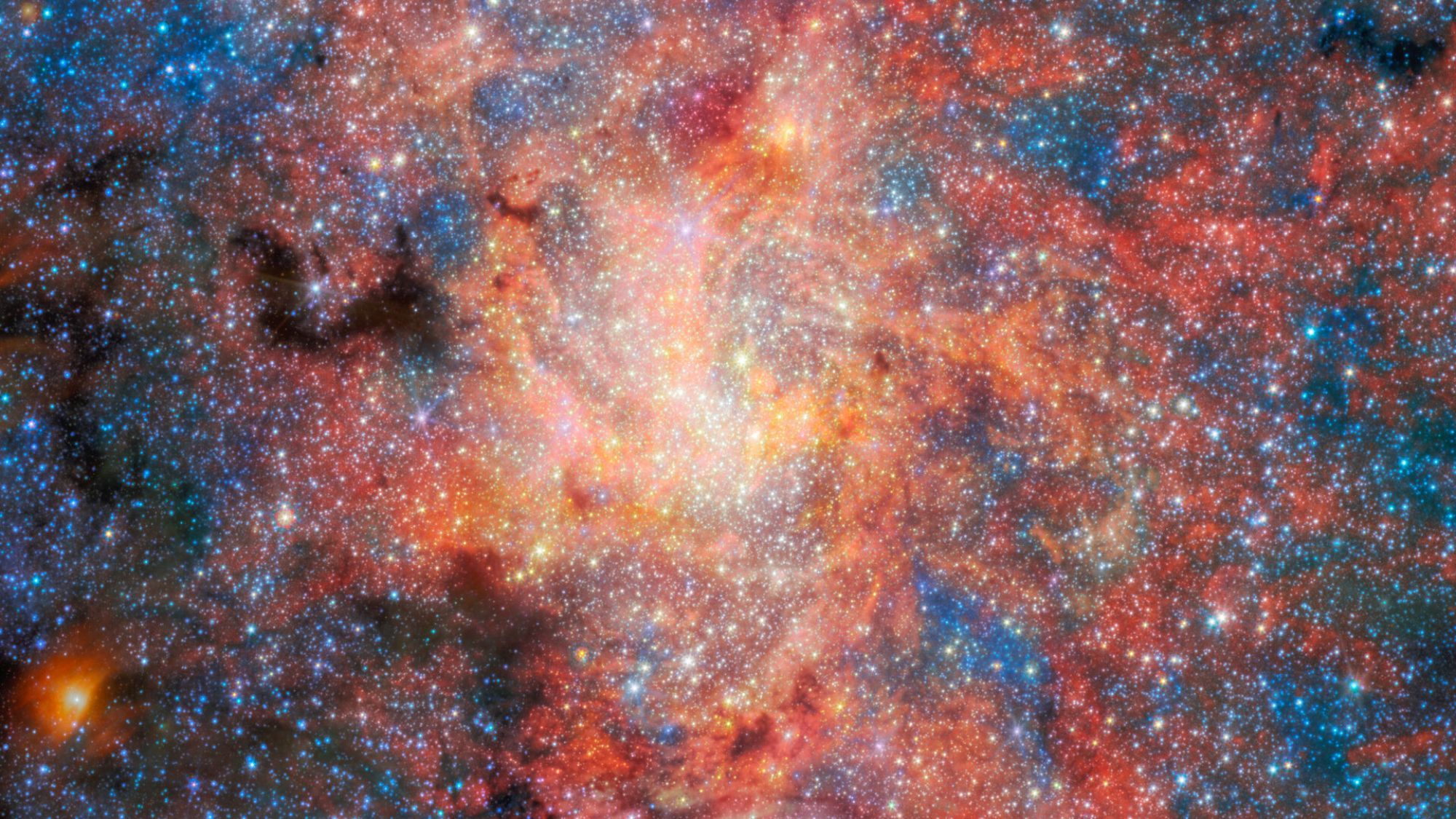

Using the James Webb Space Telescope (JWST), astronomers have made a groundbreaking discovery, detecting water and cosmic dust surrounding an aging star just 0.55 light-years from Sagittarius A*, the supermassive black hole at the center of the Milky Way. Published on August 11 in the journal Astronomy & Astrophysics, the study challenges long-held assumptions about whether molecular material can survive the extreme radiation near galactic centers.
The Resilient Nature of Evolved Star IRS 3
The target of the observation, an asymptotic giant branch star known as IRS 3, sits in the crowded and intensely irradiated neighborhood surrounding Sagittarius A*, which boasts a mass of roughly 4 million suns. Led by Florian Peißker from the University of Cologne, the research team utilized Webb’s Mid-Infrared Instrument (MIRI) to analyze the star’s light spectrum. They uncovered a shell-like distribution of silicate dust extending about 10,000 astronomical units (AU) from the star, with temperatures plummeting from roughly 927 degrees Celsius near the surface to minus 173 degrees Celsius in the outer envelopes.
A First-Ever Detection of Water in Extreme Conditions
Alongside oxygen-rich dust, the observations marked the very first detection of water within the envelope of IRS 3. Co-author Macarena Garcia Marin, an astronomer at the European Space Agency (ESA), emphasized that finding water in an environment dominated by such harsh conditions proves that molecular material can persist and potentially contribute to future generations of stars and planets. This resilience shows that dying stars act as efficient cosmic recycling centers even in the most volatile regions of the universe.
Unlocking the Secrets of Galactic Centers
The discovery reshapes our understanding of stellar evolution and cosmic recycling. By demonstrating that stars like IRS 3 can continue enriching their surroundings despite the gravitational and radiation pressures of a supermassive black hole, researchers hope to gain deeper insights into how galaxies evolve over immense timescales.