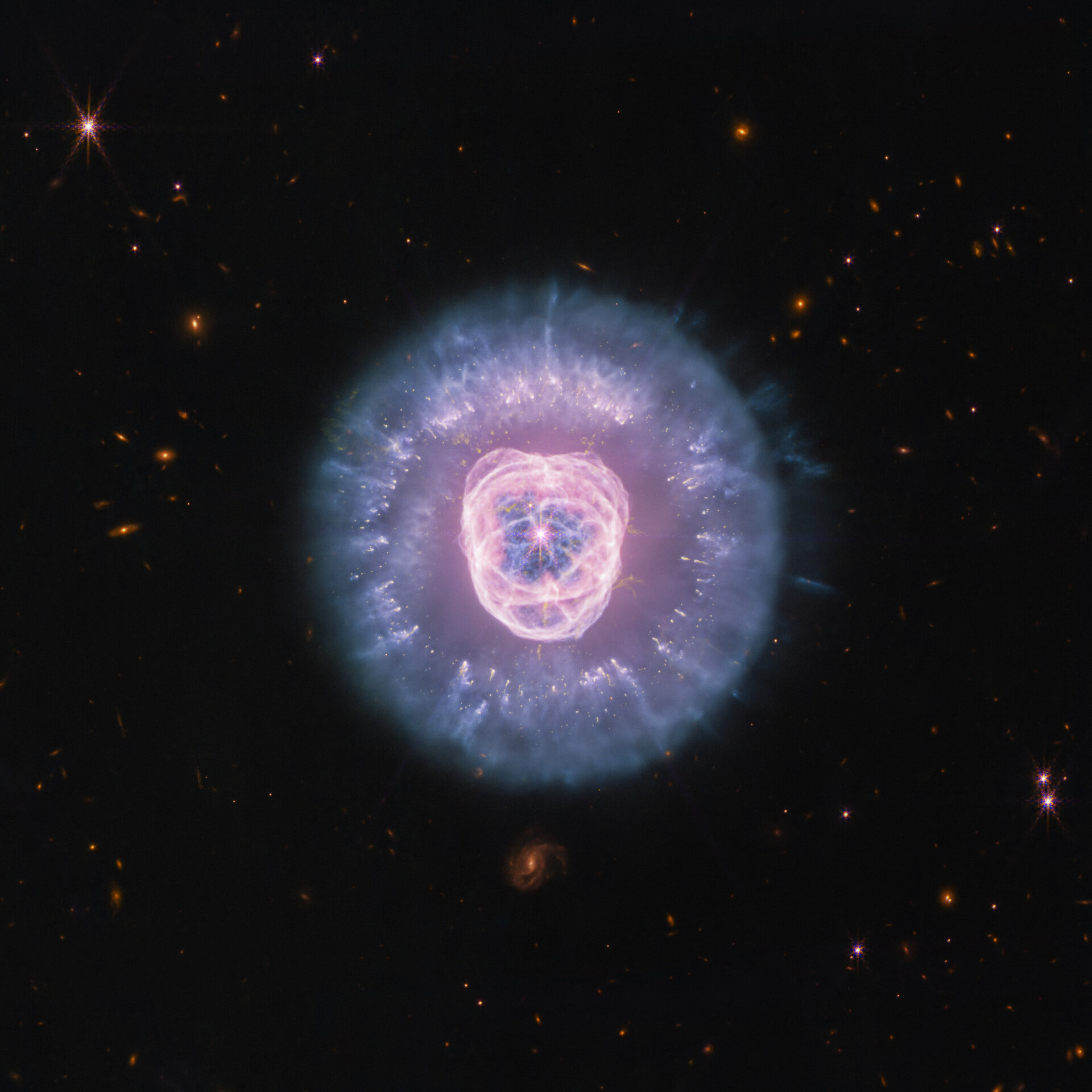

The NASA/ESA/CSA James Webb Space Telescope has captured unprecedented, high-resolution images of NGC 2392, widely known as the Lion Nebula. Operating across the starry plains of space, Webb utilizes its advanced infrared capabilities—specifically the NIRCam (Near Infrared Camera) and MIRI (Mid-Infrared Instrument)—to reveal intricate details of dust clumps and ionized gas that previous observatories could not fully resolve.
Comparing Webb and Hubble Observations
The NASA/ESA Hubble Space Telescope previously observed this planetary nebula in 2000, capturing the lion face-shaped target in visible light to reveal features like the hazy, comet-shaped mane. While Webb‘s overall structural view in infrared light appears initially similar to Hubble‘s historical visible-light imagery, the advanced telescope highlights dense clumps of dust and a hazy veil of ionized gas. This sophisticated infrared vision allows astronomers to pierce through cosmic material and study the underlying mechanics of the dying star system.
The Engine Driving the Lion Nebula
It has taken several thousand years for this massive collection of gas and dust to form its current configuration, and components of the nebula continue to undergo active transformations. The source driving these constant structural changes is a central white dwarf, acting as the remains of a dying star. Although it visually resembles the button nose of the lion, the intense energy radiating from the central white dwarf powers the complex networks of rings and shells. Furthermore, compact clumps of dust survive the intense stellar core radiation, protecting the material behind them and forming the distinct cometary tails that make up the lion’s mane.
Future Evolution of NGC 2392
Webb‘s detailed imagery effectively freezes this planetary nebula in time, yet the tumultuous effects of the stellar death continue unabated. NGC 2392 will persistently change as its gas and dust migrate away from the central core into the surrounding void. Astronomers estimate that this cosmic lion will eventually disperse in approximately 10,000 years, marking a remarkably short lifespan within astronomical timeframes.