
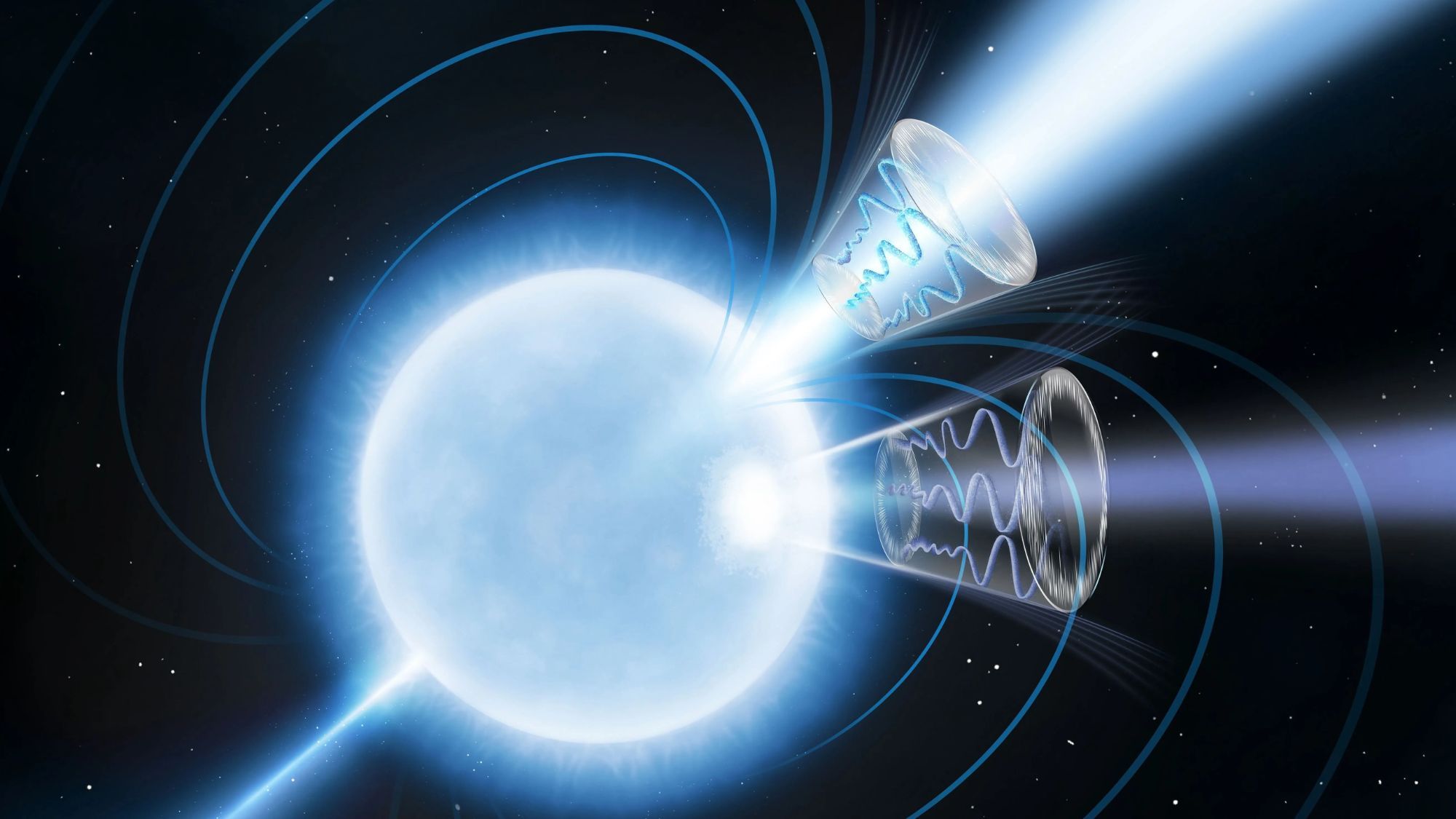

Astronomers studying the ultra-magnetic dead star 1E 1547-5408 have uncovered the strongest evidence yet for vacuum birefringence, a quantum phenomenon first proposed 90 years ago. Utilizing data from NASA’s IXPE observatory and international radio telescopes collected between March and April 2025, researchers confirmed that extreme magnetic fields can alter the properties of a vacuum, causing empty space to act like a prism and bending light.
Probing the Quantum Fabric of Reality
Empty space is far from a true void. According to theoretical work proposed in 1936 by German physicists Werner Heisenberg and Hans Euler, a vacuum is a simmering sea of virtual electrons and positrons flickering in and out of existence. While invisible under normal circumstances, these subatomic fluctuations can be influenced by immense magnetic forces. Lead researcher Rachael Stewart, a physics graduate student at George Washington University, noted that these observations provide incredible clues about the fundamental nature of reality.
The Power of Magnetars as Cosmic Laboratories
Because generating such powerful magnetic fields on Earth remains impossible, scientists rely on magnetars—the dense, city-sized remnants of massive stars boasting magnetic fields trillions of times stronger than Earth’s. Co-author Marcus Lower from the Swinburne University of Technology highlighted that nature provides these celestial laboratories to test physics under impossible conditions. Between March and April 2025, the international research team dedicated over 140 hours of coordinated observations targeting 1E 1547-5408, a unique magnetar that rotates once every two seconds.
Unprecedented Polarization Measurements
The breakthrough came when NASA’s Imaging X-ray Polarimetry Explorer (IXPE), alongside instruments like NICER on the International Space Station and Australia’s Murriyang radio telescope, detected X-rays nearly three times more polarized than standard models predicted. Co-author Fernando Camilo, who has monitored the star since 2007, expressed amazement that decades of tracking ultimately helped validate a quirky prediction of quantum mechanics. Published on August 5 in the journal Nature, the findings ensure that fundamental physical theories remain robust and intact.