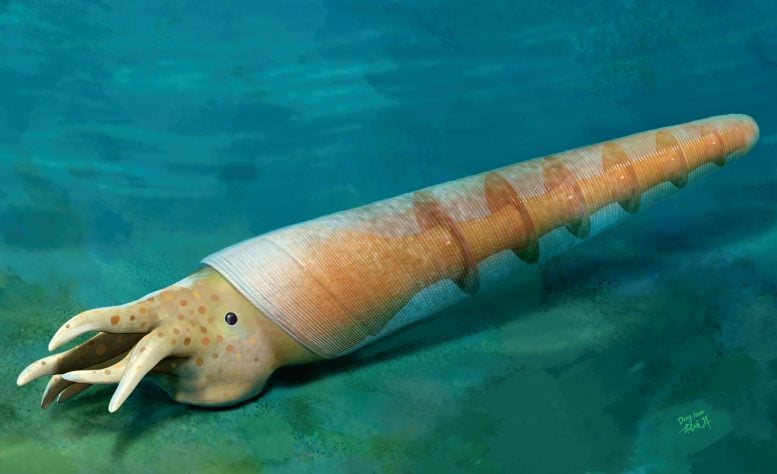

An international team of researchers has discovered a 520-million-year-old fossil in South China that sheds light on the evolutionary origins of cephalopod buoyancy. Named Eoceras shaanxiense, the tiny specimen measures only a few millimeters and features the oldest known siphuncle—a specialized internal tube that allowed ancient marine creatures to regulate water and gas balance, revolutionizing how they moved through the ocean.
Unlocking the Secrets of the Cambrian Explosion
Published in the journal Nature on July 29, 2026, the groundbreaking study was led by Junfeng Guo of Chang’an University, alongside researchers like Bing Pan from the Nanjing Institute of Geology and Paleontology and Jakob Vinther from the University of Bristol. Recovered from the Shuijingtuo Formation, the 32 preserved microfossils push back the timeline of siphuncle-bearing cephalopods by approximately 30 million years, bridging a crucial gap dating back to the Cambrian Explosion.
A Biological Ballast System
Modern cephalopods such as octopuses, squids, cuttlefish, and nautiluses all rely on sophisticated mechanisms to control whether they rise or sink in the water column. The newly analyzed fossils of Eoceras reveal an intermediate evolutionary stage between older chambered shell animals and modern species. Utilizing advanced scanning electron microscopy (SEM) and micro-computed tomography (micro-CT), scientists confirmed that the segmented tube acting as a primitive biological ballast allowed these millimeter-sized ancient predators to lift themselves off the seafloor for the very first time.